Monday, November 29, 2010

Dangerous Design


We as humans, consume all types of food in beverage for numerous reasons. For health, for pleasure, or for perceived necessity. This means that there are plenty of opportunities for the design of food, as well as the ways in which we decide which to consume it. But sometimes the things we consume can hurt us. Alcohol can be found in almost every society, in which It can bring both pleasure and pain. It seems however, only in American society that we would combine our love of intoxication, with our love of staying awake in order to achieve more (sometimes achieving greater intoxication). This combination has arisen in the form of alcoholic energy drinks that pose several issues to our society. What was designed as a way to fulfill the desire to be intoxicated while also alert, has developed into an almost epidemic leaving people hospitalized and embarrassed. The physical label design of these drinks also posses a threat to young adults who have already grown accustomed to the energy drink lifestyle that has permeated out society over the last several years.
Drinks such as Sparks, Joose, and recently Four Loko, provide customers with a potent combination of alcohol and energy stimulant. The latest, Four Loko, packs a content equivalent to a six pack of beer, mixed with several cups of coffee, all in a twenty four ounce can. These drinks appeal primarily to young adults such as college students, due to their low cost and effectiveness. Young adults tend associate drinking alcohol with activities like going to parties, dancing, listening to music, and other activities that require energy. This desire leads them to these powerful drinks that pack a major punch in a small package. The package is also typically designed similar to the average energy drink, available in several inviting fruit flavors that make it appear relatively harmless.
However the drinks are far from that. The deceiving package design seems to neglect that potency and overall danger of consuming such drinks. The mixing of stimulants (caffeine) and depressants (alcohol) has been done in bars for ages in common drinks like jack or rum and coke. However the small amounts in these drinks are no where near the explosive power of these alcoholic energy drinks. The deceiving package, flavor, and overall concept seems to avoid communicating the very present danger of these drinks. Mixing alcohol and and caffeine in large amounts can lead the consumer to thinking they are lessening the effects of intoxication, when really they are only disguising it. If someone is to consume two cans of Four Loko, they are basically consuming 12 drinks, and several cups of coffee, in only 48 oz of fluid. This can lead to devastating effects when consumed quickly, as most of these beverages are. The masking effects of caffeine will lead people to consume more alcohol, unaware of the actual toll it will take on their body. This had lead to countless hospitalizations due to severe intoxication. Putting such a potent combination in such a convenient and harmless seeming delivery method allows for binge drinkers to quickly consume a potentially lethal amount alcohol in minutes.
Not only is the package designed, but the experience it's self. American culture seems to embrace the idea that a good time involves drinking heavily, while not showing the effects. People expect to got out and drink for hours while maintaining an upbeat and fun energy. These newer beverages appeal to solve this problem in an affordable, convenient package.Luckily, U.S. Administration is catching on to the dangers and the F.D.A. Has just proposed a ban on the Four Loko beverage. Even though it is not an elegant, artistic, or necessarily useful aspect of design, the concept of an alcoholic energy beverage is a design from it's concept and recipe, to the label and advertisement it uses. This design is one that hides it's true and deadly nature.

Utopian Design Saving New Life


There are countless objects we take for granted when living in a first world country. Most of us tend to not think about our abundance of clean water, relative ease in finding food, our ability to educate ourselves with books or the internet, and other everyday norms that seem to have been apart of our lives since as early as we can remember. Another thing we take for granted are certain types of basic medical technology that allows us to survive shortly after being born. Incubators are used in all children's and general hospitals in order to ensure the survival of preterm children. Although the technology isn't cheap, it is a standard in hospitals in the United States and other first world countries. However, some countries inhabitants do not have access to such technology, and therefore face many risks when their children are born preterm. In countries that have limited health care, they may have Neonatal incubators that have been donated at one point in time, but eventually broke down and had no one with the replacement parts or expertise to fix them. This creates a problem that does not help alleviate the number of 1.8 million preterm babies that die each year from simply a lack of warmth and protection until they grow strong enough body fat and the metabolic state to stay warm.
(Image from nytimes.com)
As with every problem, there is someone (likely a designer of some kind) working to solve it. In this case, that someone is Design That Matters. The company has created the NeoNurture Car Parts Incubator. This incubator is designed specifically for regions of the world that have limited access to the resources necessary to fix complex medical equipment. How do they do this? By building it with parts of something that at least one person in almost in any region of the world can fix: a car. The NeoNurture implements a simple design that utilizes car headlights, horns, fans, batteries, and signal lights to create a simple and affordable incubator that can save lives. Headlights are used to create heat, fans are used to circulate and filter air, turn signals and door chime sounds are used to alert a nurse of vital signs, and car or motorcycle batteries are used to protect the device in movement or a power outage. With all of these simple parts, you may think that the design looks more like a steel shell rather than a piece of medical equipment, right?
Well the other aspect of the NeoNatal Incubator is that it looks, and feels good. The company wished to create an incubator that not only worked, but would also be comfortable for any baby no matter what region in the world they are from. The look of the incubator is much more pleasant than that of  standard pieces of medical technology. It shares the same clean aesthetic as most medical technology, yet it's also pleasant to look at. The designers also considered something that is lacking on most incubators designed today: mobility. The NeoNatal has two large bicycle type wheels that facilitate movement when in regions that may not have flawlessly smooth hospital floors.
(Image from nytimes.com)
The NeoNatal was a collaboration between Design that Matters, students and teacher's at MIT, Rhode Island School of Design, The University of Arizona, Stanford University, and recieved input from the well known IDEO firm. This collaboration has worked together to engineer something that is a true example of utopian design. An affordable, functional version of a normally expensive and complex medical device is something that is desired world wide. This team of designers has risen to the challenge of creating something that will save lives. Who knows? Maybe someday, one of those lives will  return the favor.

Monday, November 15, 2010

Ergonomics... In music?

(Image from RickToone.com)


Ergonomics seeks to alleviate the stress and discomforts associated with numerous everyday objects. The field has worked on tools, chairs, desks, computerware, clothing, and various other applications. One that is less recognized, (and of less concern to most) is ergonomic guitars. Anyone who has ever played a Fender telecaster, or most acoustic guitars knows that not all guitar designs are created ergonomically equal. Most popular designs that do incorporate some ergonomic values, such as fender's stratocaster with an angled body, don't solve all of the position problems associated with guitars. Some luthiers, such as Rick Toone of New Jersey, have taken it upon themselves to create a guitar that is comfortable in more ways than one.

Toone's “Dove” ergonomic baritone guitar is a combination of total functionality, with natural beauty. The materials include swamp ash and maple woods, stainless steel, bronze, and aircraft grade aluminum. I think of the look as a cross between a medieval weapon and a space-age instrument. The natural wood contrasting with the stainless steel and bronze instantly catches the eye. Not to mention the completely original body design.

(Image from RickToone.com)

The body attempts to solve all of the ergonomic issues of most electric guitars. It has a contoured body with a “Hip hole” that forms to the body for the optimal natural playing position. The wave shape of the bottom and end of the guitar serve a contours for the knee and leg, when using the guitar in a sitting position. This gives the player multiple options for placement, allowing them to find the most
comfortable position for rocking out. Also, the fretboard is a fanned design, which allows for the strings to reach their optimal length for an accurate pitch when accessing the higher regions of the neck.

(Image from RickToone.com)

This is hands down the most interesting-while-still-appealing guitar design I have ever seen. It has both function and originality. I don't see it as becoming a top selling item (mainly since it is one of a kind), but I definitely believe many axe-men/ women are trying to get their hands on one of these ergonomically correct tools for their musical woodshed.

Ergonomics in Computer Mice


As we sit clicking and typing away at our computers, we often neglect the idea that we could be harming our body. The keystrokes seem intuitive, while holding the mouse or using the pad feel like second nature. If we take a minute to take our hands of the computer and mouse and rest them naturally in front of us on a table or desk, something quickly becomes apparent: our palms are not flat on the surface. It is most comfortable and natural for our palms to rest us at a slight angle with the thumbs balancing the hand. In this manner, why would our computer products be designed so flat and flush? Most likely it is due to the aesthetic appeal of electronics that are thin and concise. But after hours of clicking away at home, I think most of us would trade in some of the looks for something not only comfortable, but better for our bodies. Ergonomic design seeks to find the balance between aesthetics and proper physical comfort. One example of this is the “wow-pen ergonomic mouse” made by the South Korean company Wow Technologies, Inc.
(Image from Impactlab.net)

The “wow pen” is known as a vertical mouse, for it's angled face and almost pen like grip. The shape is designed to be not only more natural feeling, but actually better for our arms, wrists, and hands. The angled shape helps to recreate our natural hand posture, alleviating tension and helping to reduce the chance of carpel tunnel syndrome. With the amount of time we spend on computers, more people should take this measure of long term safety into account.
When the hand is in a more natural position, it is comfortable. While some computer mice require us to keep pressure off to avoid unwanted selections (such as one-click mice), the vertical mouse can bear the weight of the hand in a natural position, relieving tension. If you are someone that would use a mouse for several hours at a time (such as a Designer) comfort should be quite important in your equipment selection. Not only is the vertical shape more comfortable, but also more relative to the way we control a pencil or pen. Having a mouse that simulates this shape allows for greater accuracy when creating computer illustrations. When a tablet is not accessible, this mouse could greatly improve a designers ability to simulate actual drawing. Ideally, this mouse would suit people in professions involving CAD design, and design programs such as Adobe Illustrator and Photoshop. The mouse also has standard right and left click buttons, a scroll wheel, and two forward and back buttons at the side of the thumb, allowing for easy access to functions within software.
Although there are numerous physical benefits of this moue, it doesn't quite hold the same aesthetic value as other mice on the market. The odd shape of the mouse seems to have posed some issues with creating visual balance in the design. Most of the mouse is covered by a plastic/rubber piece to provide grip, while contrasting with a gloss/metallic painted body displaying a logo in white text. The look is somewhat awkward and imbalanced. The colors of metallic silver, metallic pink, and metallic black don't leave many options for customization by the user. Also, the fact that it is a wired mouse takes away from any means of simplicity. There's nothing simple looking about tangled cords. If some of these aspects were addressed, I believe the “wow pen” would be a much more popular product.
Aside from it's few visual aesthetic flaws, the comfort and usability of this mouse seem to be enough to justify buying it at it's respectable price range of twenty to thirty dollars. If Wow Technologies addressed the aspects of color, and making the mouse wireless (bluetooth maybe?), I'm sure customers would be willing to pay extra for a better look that includes greater simplicity. In all, the design is very interesting and unique for an ergonomic computer mouse. I have to admit I am going to pick one up the next time I have some available funds for such a device.
(Image from alieexpress.com)


Monday, November 8, 2010

Typography Art


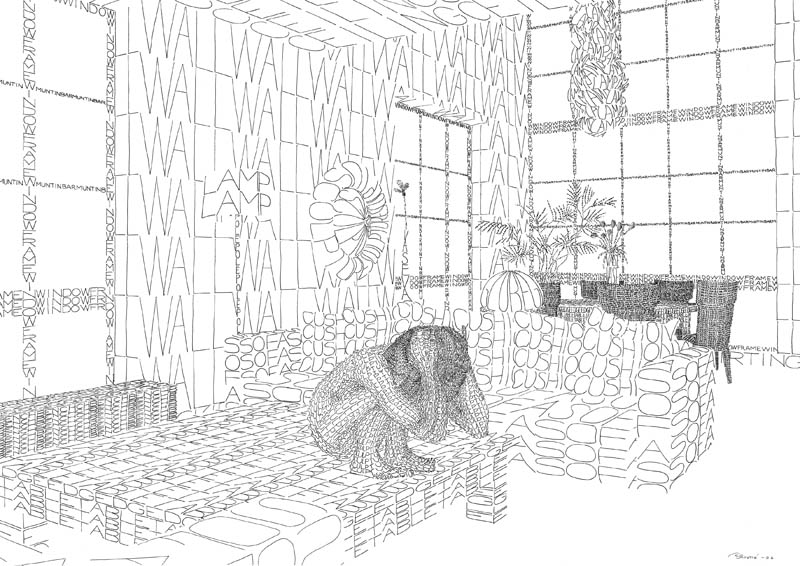
("Loft" from thomasbroome.se)


Typically words are accented by images to communicate some sort of information. People usually separate the two eve when they are together in some form of design. What about when you literally create an image out of words? This can be seen in typography and ASCII art. These methods involve the production of images using nothing but text characters and the manipulation of color.


(From http://ursispaltenstein.ch/blog/images/uploads_img/ascii_2.jpg)
There are many different types of this art. One form is ASCII art. ASCII (ask-ee) is the American Standard Code for Information Interchange and represents 128 characters that are used to represent text in computers and other communication equipment. Only 94 of these characters are actually printable and can be used to create combinations of letters, numbers, words, and sentences. The art consists of only the characters being used and spaced appropriately to give an image it's detail.

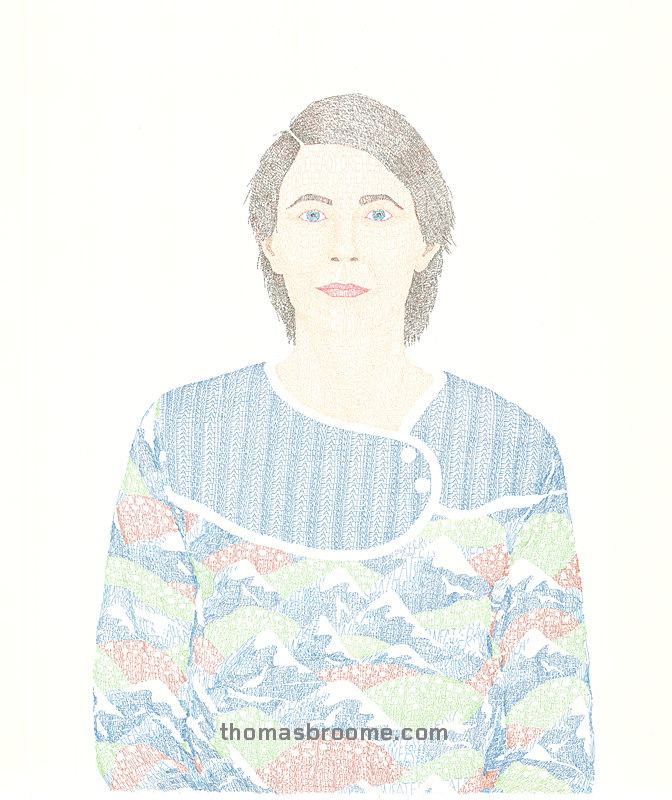
Besides the ASCII art, there is other text art that uses full words and sentences as well as the incorporation of color. These can be seen in the work of Swedish artist Thomas Broomé. Broomé does his work by hand, creating images that are completely composed of the words of the graphic content itself. Piece's like “It's Only Words (Lana)” depict lifelike images by simply using color and the names of features in the image.This type of art truly takes words and images to the utmost literal sense, leaving the artist and the audience with a clever and appealing visual experience.

("It's Only Words" Thomas Broome)
Typography art is not always conveying a message, as seen with ASCII. It also may appear to be more for an awe effect of the amount of time the work must have required. However both are interesting ways of combining text and image into one coherent and appealing image.

Brian Feis: Words and Images in Comics


(Image from Planetmarkus.com)

Words and Images seem like different forms of communication, when in fact the most successful communication combines both of these aspects. This type of communication is used in everything from advertisement and signage, to the wonderful world of comic books. On Tuesday November 2nd, design one had the privilege of hearing graphic novelist Brian Fies talk about his creative process, as well as underlying principles of comic book design. Throughout the lecture, Fies referenced interaction between words and images by showing examples from his book; “Mom's Cancer” .
“Mom's Cancer” depicts the family ordeal Fies's mother's battle with incurable lung cancer. The material began as a web comic and a way for Fies to cope with the situation, but soon ballooned to such popularity that Fies received an offer to publish the comic as a full book. Throughout the book Fies uses words and images to explain the experience of his mother undergoing cancer treatment, and the experience dealing with the traumatic situation. Fies stated that his process starts with words. Not only does he develop the script, but also decides on the location of the words to guide the position of the images. He then illustrates the the script he has created. By creating the words first, Feis can create images that solidify his message and bring better understanding to the reader. The images work to enhance the story already being told by the words.
(From http://markc1.typepad.com/photos/uncategorized/cancer_comic.jpg)
One of the most interesting aspects of Fies's book, as well as the comic medium in general, is the ability of different types of images to convey different levels of reality and emotion. This relates back to the idea of gestalt psychology in comics, and as Fies said “Distilling something to it's essence”. Feis could have designed each character (especially his mother) with great detail, implying a greater sense of reality, but instead chose a simpler character design that allows the viewer to see the characters as more universal. This allows readers to place themselves in the situation, allowing them to deal with a similar situation as to what Feis and his family dealt with. While the words remain the same, the choice of images to depict those words  can greatly alter the mood and overall effect of a comic.


Monday, November 1, 2010

Innovations in Electric Guitar Design

(Image from creamcitymusic.com)

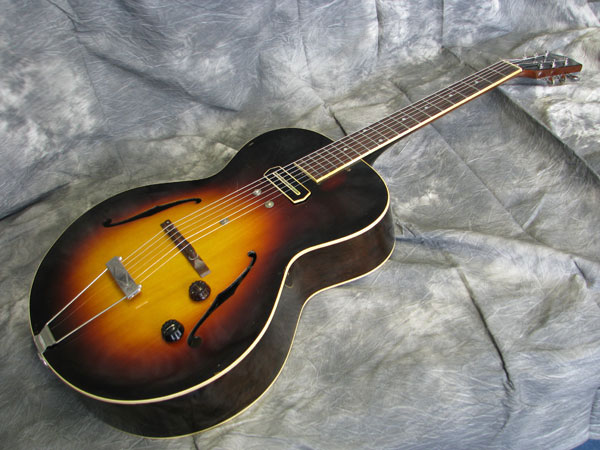
The first electric guitars were little more than acoustic guitars outfitted with a pickup to create and amplified signal in order to hear the guitar player in a jazz big band. Over the years, through countless design innovations, the electric guitar has transformed into shapes and forms to serve every purpose. The main impacts of electric guitar design innovation have been increased comfort, increased musical range, and more overall sonic possibilities.
(Image from Fender-Stratocaster.com)
The shape of a standard acoustic guitar usually consists of a rounded body that closes off at both sides of the guitar neck. The body is hollow to allow the sound to to be amplified. With the advent of guitar pickups, which transmit the vibrations of metal strings into an electric signal, the shape of the guitar could take on any form. This has allowed for thinner, more ergonomic bodies, such as that of the fender stratocaster. With these more natural and comfortable shapes, guitarists can further relax in their playing, which is a necessity for developing proper and consistent technique. This change in shape also allows for comfort a guitar player may need to stand for a long period of time.

(Image from Wutzdog-Guitars.de)
Along with the ability to achieve ergonomic shapes, the ability to change the traditional body style created designs that promote access to the entire guitar fretboard. This allows players to easily utilize the entire range of the instrument, therefore being able to play more notes, as well as more variations of the same note or chord. In this sense, players could discover new ways of playing the guitar.Although the concept of the cutaway guitar did not originate with the electric, the ability to easily manipulate the body without changing sound made it more prevalent.


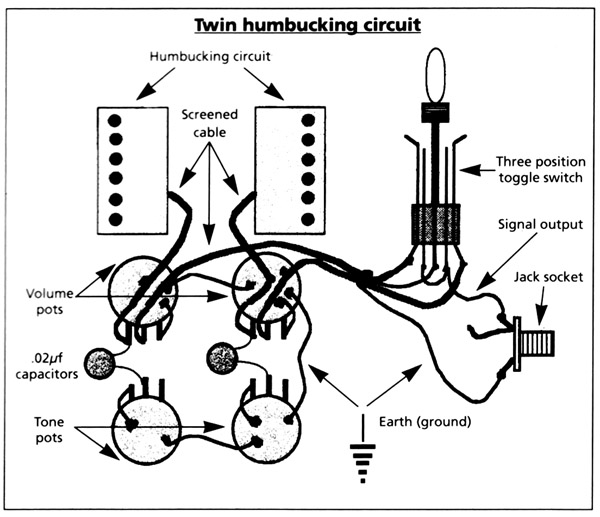
(Humbucking Pickups- Image from dacetech.com)
With the advent of the electronic pickup came a new way to  alter the way a stringed instrument sounds. Electronics in guitars allow for the alteration of equalization of the signal, as well as the entire signal itself. For example, the standard Gibson guitar design consists of two Humbucking pickups each with their own volume and tone knob, and a switch to use either one of or both pickups at the same time. These options instantly create thousands of sound opportunities compared with a standard acoustic guitar. Couple those possibilities with an amplifier that has it's own tone equalizer and volume adjustments, and you have thousands of more possibilities. With the addition of guitar effects, these possibilities have allowed individual guitarists such as Jimi Hendrix, Jimmy page, David Gilmore, and countless others to develop a distinctive sound that can be instantly recognized.


(Image from thegearpage.net)

These changes in guitar design may appear to be somewhat small, but their impact has played a large role in shaping the music we have been hearing for over seventy years. If the deign of the guitar form and content had not changed, the music we know would not exist. Due to the change in the guitar's shape and output, we have increased it's comfort, increased it's range, and created sound possibilities that will continue to be explored for generations.

ipod Nano (5th Gen.)


The advent of the mp3 player created a complete shift in the way we access, buy, and listen to music. With the development of hard drive space, mp3 players became more and more a reality as companies could fit more songs onto a single device. Throughout the past ten years, one device has dominated the market: The Apple ipod. The ipod's combination of sleek and simple form both on the outside and within, have made it one of the most iconic pieces of technology of my generation.
Apple has produces over 6 generations of the traditional ipod, with several other models along the years. The 5th generation ipod nano packs an incredible amount of features and storage space in a thin, smooth casing. The model boasts 16GB of storage space, while also housing an FM radio tuner, a video camera, alarms, calendars, games, voice memos, a stop watch... and of course the ability to store and play music, images, and video.The shape of the device is a thin and rectangular with elliptical shaped depth, allowing the device to rest nicely in the palm. My particular model is a charcoal grey, which is accented by a black frame around the screen, as well as a black click wheel. The texture of the devices is glossy and smooth. The edges are rounded off, making it sometimes hard to hold unless your hand is behind it. The overall layout has an a-symmetrical balance, with the screen taking up most of the device, balanced by the compact wheel at the bottom.

Beyond the exterior, the ipod has it's own distinct graphic user interface that reacts to a touch sensitive click-wheel. The GUI is a simple illuminated white screen, with a silver information bar at the top, and a black text list of functions the iPod can perform. The unique feature that apple is known for is the touch sensitive wheel that allows the user to smoothly scroll through the device's contents, control volume, and scroll through album covers to select a particular artist. This smooth scrolling that makes the device feel like more than a mere music player. Also, switching between menus and songs is followed by a short, transition that smoothly navigates the user through the device. This again creates a smooth elegance that helps develop a sense of beauty within the iPod.
After almost ten years on the market, the iPod has been widely copied, yet very few have come close to replicating both it's physical attractiveness and simple, flawless user interface. This is a perfect example of Apple products and why they are so sought after. A music player should not leave the user questioning how to get to their music. It should be simple, concise, and above all, something the user will want to have with at all moments in their lives.

Objectified: Form and Content


The film “Objectified” directed by Gary Hustwit, is a look at industrial design and it's presence and impact in our everyday lives. The film interviews several designers who all discuss design, as well as the importance of form and content. Although the designers have somewhat different perspectives, their similar view is that good design should not be noticed as design. Good design should be simple and feel natural.
To refresh the memory, let's define form and content. Content is the “subject matter, story, or information that the artwork seeks to communicate to the viewer”. Form is “The purely visual aspect of design” or how a designer says something. In this sense, content usually influences form. Jonathan Ive, VP of industrial design at Apple is well educated in the relation of from and content. He believes that form should develop in a manner that causes the consumer to believe it was inevitable, or “Of course it's this way”. Examples of this are present in every apple product from macbooks, to iphones. Apple's simplicity reflects the idea that products should require no extra thought, which is is the power of good design.
In regards to designs such as Apple's iPhone, it is mentioned in the film that form is not necessarily connected to function, due to the advent of the microchip. In cellphones, computers, video games, mp3 players, etc, the microchip has allowed digital interfaces to control what an object does. This changes the connection between form and content creating two levels of form. One level is the exterior of the actual device, while the second is the user interface of the software on the device. Someone who has never seen a cellphone would have a hard time understanding what an iPhone is.
Bill Moggridge, co-founder of the IDEO design group, also makes reference to the idea of “digital form” when discussing his design of one of the first laptop computers. Moggridge states that after spending so much time on the industrial design of the computer, he soon forgot it all as he became fascinated with the user interface design. David Kelly, another member of the IDEO team believes that “people need to demand that design performs for them”. In the field of user interface design, the interface should always be simple and understandable. If this is not the case, then the designer has failed, not the user. Kelly again brings up the idea that the most successful design is simple, natural feeling form.
The documentary really opens ones eyes as to how much of our lives is affected by industrial design. Everything around can be judged as to how well the form represents the content. Almost every item we come into contact with has been considered by a designer in order to achieve a successful form that accurately connects with the user.

Monday, October 18, 2010

Authentic Chuck

(Image from metrophotochallenge.com)

I can't say I know much about fashion. I'm a pretty simple guy when it comes to clothing. I have always been that way. At times I felt strange for not having a desire to wear clothing blasted with company logos, especially in my younger years. But as I have grown, the plain style has grown to suit me well. One thing I enjoy most out of any piece of clothing, is a great pair of shoes. I'm not talking about accessorizing and owning ten different pairs to match my mood for the day, but rather a few good pairs of shoes to get me by until they eventually disintegrate into mangled rubber and canvas. Two styles that share similarities, as well as my appreciation, are the Converse Chuck Taylor lo-tops, and the Vans Authentic. Both are simple, functional shoes that have served their purpose for far longer than I have been able to wear them.

(Image from consumie.com)
The Converse All-Star was first produced in 1917 as Converses answer to the public need of a Basketball shoe. The shoe did not catch on until renowned basket ball player of his time, Chuck Taylor, adopted the allstar as his main shoe for playing in. From there, the shoe grew throughout the world of basketball, continuing to grow until it had become the standard shoe for any serious basketball player. The original All-Stars were a rubber vulcanized sole, with a high-top canvas body, consiting of 16 lacing eyelets, as well as two additional eyelets for ventilation. The shoes most notable feature is the rubber toe cap 
that is a continuation of the sole. 

(Image form Zappos.com)
The vans authentic originated in 1966 as the “#44 Deck Shoe”. The design consists of a “waffle grip” vulcanized rubber sole, a canvas body, and ten lace eyelets. What started out as simple sturdy shoe grew to prominence in the 1970s when skateboarders discovered their perfect fit for the sport. The shoes have been popular amongst kids, teens, men, women, punk rock bands, hip hop artists, and basically everyone in between.

 Both of these shoes share a similar design, as well as use of materials, however, they look signifcantly different. The Converse toe cap and elongated body contrasts with the Van's all canvas and slightly shorter body. The all star originated as a basketball shoe, while vans originated as a leisure shoe that eventually was adopted and praised by the world of skateboarding. Converse also initially started on the east coast, while vans originated here in sunny California. Aside form these differences, the shoes are actually very much alike.

Both vans and converse have developed into a footwear phenomena in terms of the amount of boundaries they have crossed. People from all walks of life have worn these shoes. Both shoes now come in various patterns and colorways, including limited and custom made editions.Both claim some association in the world of alternative music such as punk or grunge, as can be seen in the converse sporting Ramones, or vans equipped bands of modern punk. Although vans originated the skate shoe, converse has caught onto the hype and even has their own skateboarding line and team. 

Converse and Vans have become synonymous with american popular culture. They have covered the feet of millions while those wearing them set trends and broke boundaries. Not only were these trendsetters able to accomplish such feats, but they were able to do them with nothing more than some plain canvas vulcanized shoes tied to their feet.

Sunday, October 17, 2010

Communication Through the Remix


Music can be design. Music tries to convey ideas or images through sounds and words which are then interpreted by the listener in their own way. As we go forth in this technological age, music is more abundant, more accessible, and more technologically influenced. But what about the listeners talking back to the musicians themselves? Surely this can be done literally through chats, emails, message boards, or even in person with physical expressions at a concert. But what if the listener was to actually take what they heard, physically change it, then give it back to the initial artist? This is done through the remix.

While anyone can create a remix, the world of the internet has made it so those mixes can be shared with everyone. This ability to connect has made some artists interested in what others would make of their music.Upon release of an album, some artists promote “remix contests” allowing listeners to take a certain song and remix it however they would like. This was most notably done by the band Radiohead on their last album “In Rainbows”. The concept was to allow users to download the separate recorded tracks (ie: bass, drums, guitars, vocals, etc) to facilitate the ease of remixing. The first song posted for the contest (“Nude”) received such a profound response that Radiohead later posted another song from the album (“Reckoner”),to allow for more remixes to be posted and voted upon. This concept has also been adapted by artists such as Trent Reznor (Nine Inch Nails), and Third Eye Blind. Although there are no real rewards for “winning” the contest, the top remixes get the bands recognition.

The idea of allowing fans to manipulate an artist's work is very intriguing. In the case of the band Third Eye Blind, the band released some of the song stems before they had released the album, allowing fans to influence the final result. Only in today's world would fans be able to actually have input on the outcome of an artist's next record. This is truly communication through design; by allowing a musician to create something, give it to their fans to alter, then have it given back in a new shape and form. I feel this will be a continuously increasing event that artists will take advantage of to get feedback upon their work. In the near future we may even see bands writing music with the help of those who listen to it, creating the ultimate form of communication in design.

Tuesday, October 12, 2010

Stove Top Simplicity

 
I love coffee. It has surrounded me since the day I was born. My earliest memories consist of my dad brewing large 6-8 cup pots every morning (for solely himself), drinking about half of the pot, then leaving the rest to possibly be devoured later. Throughout my childhood I remember there always being coffee in the pot, and always that strong aroma in the air. In the beginning of college, my sister introduced me to espresso . Not only did she show me espresso, but also one of the most ingenious/iconic inventions in the world of coffee. The Bailetti Moka Pot.

This stove top espresso maker made by italian designer/engineer Alfonso Bialetti in 1933 quickly became popular throughout Italy and across Europe. Today it is still a staple in Italian kitchens and homes, as well as present on display in the London Science Museum. The simple look and design consists of a 3 part aluminum pot: the base which is filled with water, the metal filter which holds the ground espresso, and the top chamber which collects the piping hot steamed espresso. The pots come in various sizes, allowing for a single shot, or up to 18 at once.
I find the look of the Moka Pot very unique. It's flared straight edges and formed spout give it looks of a cross between an hour glass and a tea kettle. The simple aluminum and black coloring makes it look sleek, but also made for everyday use. Besides it's looks, the best feature of the Moka is that it actually works! Such a simple concept executed appropriately and with style. I highly recommend these to anyone who enjoys coffee or espresso. Even if you don't, just get it to give your average kitchen a little bit of italian culture.

Sunday, October 10, 2010

Design From Without


As a designer, it is essential to use your surroundings to find inspiration. One can only look inside for so long before needing to expand upon their creative potential. In recent years environmentally sustainable design has become a major focus, requiring designers of all types to look to the natural world for ideas that convey beauty with sustainability and functionality. An outstanding example of this is the design of the California Academy of Sciences located in Golden Gate Park in San Francisco, CA. The main design was conceived by renowned Italian architect Renzo Piano.
 
The museum incorporates many sustainable elements such as a natural cooling system, solar power, natural lighting, and insulation made from recycled blue jeans. However, the most standout part of the museum rests right on top. The 197,000 sq ft. roof is covered by several hills emulating the San Francisco topography. These hills also conceal the large structures within the building including a planetarium, a four story rainforest, an aquarium, and a natural history museum. The roof also incorporates1.7 million native plant species chosen specifically for the region. Piano said of the design that "it was meant to look as if it had grown out from under Golden Gate Park”. The roof design is not only aesthetically pleasing, but also serves several sustainable purposes. Having a roof made of soil and plants vs. asphalt, reduces the heat within the building by 10 degrees. The roof also captures rain water to be reused, converts carbon dioxide into oxygen, and reduces the overall amount of energy needed to heat and cool the building.
This design is truly fascinating, as well as a perfect example of seamlessly combining a museum with the natural park environment. Piano and his team were able to realize a truly innovative way of combing nature with architectural design. This combination shows the major influence that the designer had to pull from the environment, thus finding creativity from without.

Saturday, October 9, 2010

A Fine Soup

On October 6, 2010, Design 001 at UC Davis cooked up some soup... of the stone variety. The concept of stone soup is to create something with the collective effort of a group, in order to benefit all who participate. For desgin 001, this involved seven individuals bringing their own materials to combine and create a piece of artwork. In many ways it felt reminiscent of a kindergarten activity, but not in a negative way. This activity allowed our group to get to know each other better as individuals and designers, as well as work together to make something out of (almost) nothing.
Upon selecting our location for working, we unloaded our materials onto the lawn and observed our newly formed junk pile. Materials ranged from paper bags and cardboard, to old bike tire tubes and glitter glue. In a situation such as this, we took the standard design approach and decided to start sketching. However, upon glancing at the materials in front of us, we decided against sketching and thought it would be more efficient to dig in and start shaping our work. Upon showing the group a large piece of brown packing paper that I brought, there was an instant reply of “That would make a great tree trunk”. From that simple idea our project goal was formed. We would create a tree out of  junk.
In order to create an upright tree trunk, we decided to use a nearby lamp post as our means of forming it. As we wrapped, someone decided to intertwine the bike tubes with the tree, giving a “vine” effect. Before long we were wrapping and stuffing materials all over the trunk in order to create a “Recycled Junk Tree”. As the process continued more and more ideas flowed, such as creating branches from paper bags and cardboard tubes, as well as leaves from green coupons in a coupon book. The culminating figure in the piece was a cardboard box wrapped around the base of the post, in order to give the effect that this junk tree had grown right out of the box of junk.


Upon completion, we took a step back to realize we had just created a concept, and built without much planning or strategy. Although this may not be ideal design practice, it is a perfect way to stir one's creativity and expand it through the ideas of others in the group. That is what our stone soup was about: utilizing group creativity to create something that would benefit each individual involved. Once the activity was over and we ventured to observe other groups designs, I couldn't help but constantly think of new ideas of ways to improve our piece, as well as entirely new concepts for the same materials. It was truly a valuable experience for exercising one's creative mind.

Monday, October 4, 2010

Place of Design


Design serves multiple purposes in our society. This is the reason it encompasses everything around us. While most probably think of design as a means of commerce, it also expands into the worlds of informational, as well as political. Whether or not there is a client involved, a designer is trying to create an attractive, informative, and effective piece that captivates the attention of all who view it.

In business, design is essential. Product design is a constant competition for the next big idea that will sell. A company such as Apple, has consistently put out functional as well as beautiful products. Besides the products themselves, companies need designers to create identities and ad campagins. In Apple's case, this continued along the lines of simplicity, as seen in the white backdrop t.v. Commercials. These concepts are probably most thought of when mentioning graphic design, however, some create designs with less monetary motivation.

Design can serve as a powerful tool in the world of politics. Propaganda and anti-war posters present a view point in a way that simplifies the meaning to the viewer. These posters have been seen in times of war, as well as presidential campaigns. Two examples are the recent Obama “Hope” poster designed by artist Shepard Fairey, and the uncle sam “I Want You (For the US Army)” image designed by James Montgomery Flagg. Both of these images have become icons that every American can identify. Designers have the power to create an association between image and idea in a way that can have a profound impact on societies for years to come

Besides the ideas of business and politics, designers also create images for simple informational purposes: A sign telling us which restroom to use, a sign telling us to STOP, a sign telling us where to go, or a diagram showing us how to safely attach our oxygen masks in case of aircraft emergency. All of these images may appear simple, but thats the point. Simple and effective. We depend on these signs day in and day out, often taking them for granted.

The place of design in society is not a simple question. Truly, designs place is everywhere. Whether or it was created for profit, ideal, information, or all three, it is ingrained in our society.

Hearing Design


As we have discussed in class, design is not simple to define. It can be seen as both a noun and a verb. It can be in the form of a book cover, a home, a water bottle, and much more. In some cases, it can even be sound. Sound design is a media field that does not get enough recognition. In films, sound is often viewed as secondary to the visual aspect. However, watching a film with poor sound (or no sound) can completely change the impact of the work. In today's age, sound design is also used in games, websites, television, and commercials. This creates numerous opportunities for sound designers to create sonic landscapes that accurately portrait an image, as well embellish the actions taking place on screen.
Diego Stocco is a sound designer and composer that takes both fields to new creative heights. Stocco builds his own instruments out of musical leftovers, as well as uses the natural environment as an instrument within its self. His unorthodox approach to creating compositions sets him apart by capturing sounds that may have never been heard before. Diego's website, as well as his vimeo page will give you an idea of the type of work he is creating.

Diego Stocco - Bassoforte from Diego Stocco on Vimeo.

Diego Stocco - Music From A Bonsai from Diego Stocco on Vimeo.
I had first heard/seen Stoccos work from watching an interview with him on a web-series known as “Motherboard”. I then re-stumbled across this work recently, which allowed me to see it in a new light. It made me think more about concepts of design, and how design can even be in sounds we hear. Sound can be similar to other design mediums in the sense that it is something asked for, and is needed to be realized and “Designed” by a sound designer. It needs convey a feeling that will hopefully produce a mental image, or appropriately match a physical image on a screen. Stucco Does this in a fascinating way that goes beyond mere sound effects, but creating new sounds that may have never been heard before.

Saturday, October 2, 2010

Early Impact of Design: A Coveted Design


From the moment of birth we are exposed to the world of design. It surrounds us from that moment on as almost everything we come into contact with is designed. This gives us numerous opportunities in our early years to discover the impact of design through interactions with toys, games, movies, furniture, rooms, etc. With all these opportunities, it wasn't until eight years old that I had a truly significant experience with a particular product of design. It was a design by Leo Fender, George Fullerton, and Freddie Tavares.
My uncle Tony introduced me to the electric guitar. More specifically, the Fender Stratocaster. The first time I saw a real electric guitar in person, it was a 50's style white Fender Stratocaster with a maple neck. The smooth gloss finish over the maple neck and ergonomically designed white body was beautiful. More captivating was the contrast of materials consisting of wood, plastic, and various metals, intertwined so as to draw your attention away from the materials, and make you focus on the instrument as a whole.The smell of the guitar was a combination of the polyester coating mixed with the wood, and nickel coating of new strings. A scent that is part manufactured, and part organic. 

(Image courtesy of fenderstrat.net)
Beyond it's appearance, the most important aspect of this guitar is it's sound.The Stratocaster's five way pickup switch allows it to create some of the most beautiful sounds possible on an electric guitar. It ranges from a deep buttery bass frequency, to a hi/midrange twang allowing endless possibilities in between. It is not the most simplistic guitar yet for the features it possesses, it's control layout is organized neatly and effectively.
The design of the Stratocaster has influenced hundreds of imitations trying to achieve it's coveted style. It is a style that made me as well as countless others, take notice of the world of guitar playing. It's combination of aesthetics, physical playability, and numerous sound capabilities make it one of the most popular guitars in the world.